
I Hit a Deer. Is That a Claim, and Will It Raise My Rate?
Key takeaways
- Hitting a deer is almost always a comprehensive claim, not a collision claim, and comprehensive usually carries the lower deductible.
- If you swerve and hit a tree, a guardrail or another car instead of the deer, that flips to a collision claim and is generally treated as at fault.
- Maryland DNR reports that suburban deer densities run higher than rural ones, so Montgomery, Howard and Fairfax counties are not the safe end of this.
- Virginia DWR estimates one-half to two-thirds of all deer-vehicle collisions happen in October, November and December.
- If you carry liability only, there is no coverage for your own vehicle, no matter what ran into the road.
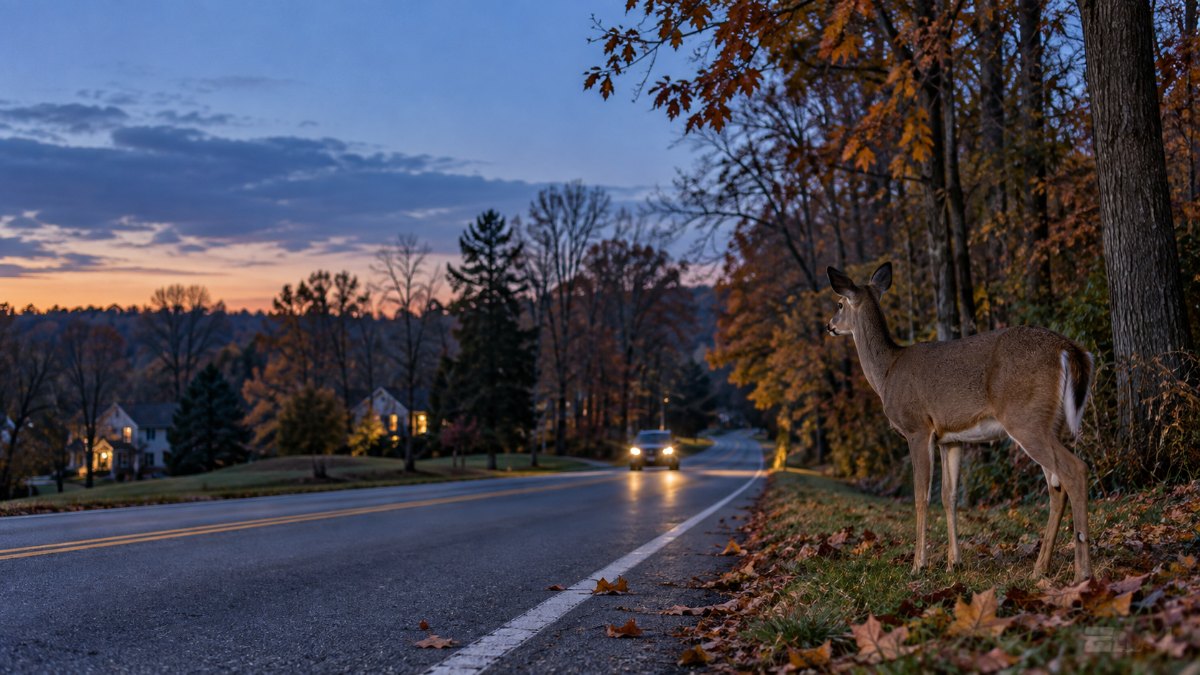
It happens fast enough that most people cannot describe it afterward. A shape at the edge of the headlights on Route 15 north of Frederick, or on Route 7 through Loudoun County, and then the sound. You pull onto the shoulder, your hands are shaking, and the first coherent thought is usually some version of the same question: is this a claim, and is it going to cost me at renewal.
Here is the straight answer, and then the parts that actually matter.
The short answer
Yes, it is a claim, and yes, it is covered, assuming you carry comprehensive coverage on that vehicle. Your deductible applies. For most drivers in our area that deductible is somewhere between 250 and 1,000 dollars, and it is often lower than the collision deductible on the same policy.
Where people get surprised is not whether they have coverage. It is which coverage pays.
Comprehensive and collision are not the same thing
These two coverages sit next to each other on your declarations page and get treated as interchangeable in casual conversation. They are not.
Collision pays when your car hits something, or something hits your car, in a crash. Another vehicle, a pole, a curb, a guardrail.
Comprehensive pays for damage that happens to your car outside of that. Theft, vandalism, fire, hail, a tree limb coming down in a storm, and animals.
An animal strike falls under comprehensive at essentially every carrier writing in Maryland, the District and Virginia. That distinction is worth real money to you. Comprehensive claims are rated differently than at-fault collisions, the deductible is frequently lower, and the claim is not recorded as an accident you caused.
The distinction is also fragile, which brings us to the part of this article worth reading twice.
The mistake that turns a comprehensive claim into a collision claim
Every instinct you have says swerve. Do not.
The Virginia Department of Wildlife Resources puts it directly in its guidance to drivers: apply the brakes, stop if you have to, but never swerve out of the lane to miss a deer, because a collision with another vehicle, a tree or another object is likely to be more serious than hitting the deer.
Maryland’s State Highway Administration has run the same message for years under the line “never veer for deer,” and its reasoning is worth repeating because it comes from crash reports rather than theory. The agency has described seeing crashes where drivers lost control and vehicles left the road, often severely injuring the people inside.
There is a coverage consequence stacked on top of the safety one. Hit the deer and you have a comprehensive claim. Miss the deer and hit an oak tree, a bridge abutment or the car in the next lane, and you have a collision claim, at fault, with the higher deductible and the surcharge that goes with it. If someone else is injured in the process, your liability limits are now in play too.
Brake hard, stay in your lane, keep both hands on the wheel. It is counterintuitive and it is correct.
Will it raise my rate?
This is the question everyone actually wants answered, and the honest response has some texture to it.
At most carriers, a single comprehensive claim on an otherwise clean record is not what moves a renewal. It is not charged the way an at-fault accident is charged, because you did not cause it.
Two things can still bite. The first is a claim-free or accident-free discount, which some carriers will remove for any paid claim regardless of fault. The second is frequency. Carriers look at the pattern more than any single event. One deer strike in five clean years reads very differently than a third claim of any kind inside three years.
Practices vary meaningfully between carriers, and that variation is exactly the kind of thing worth a two minute phone call to your agent before you file rather than after.
When filing is worth it
Run the math before you decide. Get a repair estimate, compare it to your comprehensive deductible, and give yourself room.
Deer damage is rarely cosmetic. A strike at speed takes the grille, the hood, the radiator and a headlamp assembly, and on anything built in roughly the last decade the front bumper is also carrying radar and camera modules for automatic emergency braking and adaptive cruise. Those have to be replaced and recalibrated. A repair that would have been 2,000 dollars on a 2010 sedan is frequently multiples of that on the same size car today.
If the estimate lands well above your deductible, file. If it clears the deductible by only a few hundred dollars, that is the conversation to have with your agent first. The same logic we walk clients through on property claims and deductibles applies here.
What to do in the first twenty minutes
- Get off the road. Hazards on, as far onto the shoulder as you safely can.
- Check everyone in the car before you check the car.
- Call it in. In Maryland and Virginia, a deer strike with damage should be reported, and you will want the report number.
- Photograph everything. The damage, the scene, the position of the animal, the road, both directions of travel.
- Stay away from the deer. Both Virginia DWR and Maryland SHA are explicit about this. An injured deer is dangerous and moves faster than you expect.
- Call your agent. Not the 800 number on the back of the card, your agent, who can tell you whether filing makes sense before anything is on record.
The rules about the deer itself
People ask this more often than you would think, and the answer is different on each side of the river.
Virginia lets you keep the animal. Under Virginia Code 29.1-539, you report the accident to a conservation police officer or local law enforcement in the county or city where it happened, the officer views the animal, and you are issued a possession certificate.
Maryland requires a deer salvage permit from the Department of Natural Resources before you can take possession. Do not load it into the truck and sort it out later.
The District is simplest. Report it and leave the animal where it is.
The suburban part nobody expects
Most people assume deer risk is a rural problem and that a commute through Rockville, Columbia or Vienna is safer than one through farm country. Maryland’s Department of Natural Resources says the opposite is true.
In its own explanation of deer management, DNR notes that deer numbers run higher in suburban and urban areas than in rural parts of Maryland. The reason is straightforward once you hear it. Deer thrive where woodland is broken up by open space, which is a precise description of a subdivision. Development clears some lots and leaves others wooded, new homeowners plant ornamental shrubs and seed lawns, and the habitat gets better rather than worse. At the same time, hunting in those areas is restricted or eliminated. Better food, less mortality, more deer.
DNR goes further and attributes thousands of deer-vehicle collisions in Maryland to suburban populations sitting above what it calls the cultural carrying capacity. If you drive the 270 corridor or the Beltway feeders, you are not driving through the low-risk zone.
When the risk actually peaks here
Deer are not evenly dangerous across the year, and the spike is sharper than most drivers realize.
Virginia DWR estimates that one-half to two-thirds of all deer-vehicle collisions occur in October, November and December. The agency puts Virginia’s white-tailed deer population at roughly one million animals at this time of year.
Maryland DNR explains why the window is that tight. The vast majority of white-tailed deer in Maryland breed during the first two weeks of November, and the breeding activity that drives it starts ramping up in October. That behavior is what pushes deer across roads. A female’s home range is normally about a square mile, but adult males range five miles or more, and young bucks disperse farther still as they leave the range they were born in.
Add one more thing to your calendar. Clocks fall back in early November, which drops the evening commute straight into the dusk window when deer are most active. The roads do not change. The light does.
Frequently Asked Questions
Does comprehensive coverage pay if I hit a deer?
Yes. Animal collisions fall under comprehensive coverage at essentially every carrier, subject to your policy terms and your comprehensive deductible. If you do not carry comprehensive on that vehicle, there is no coverage for your own car.
Is hitting a deer considered an at fault accident?
No. Because it is handled as a comprehensive claim rather than a collision claim, it is not recorded as an accident you caused and is not surcharged the same way.
What happens if I swerve and miss the deer but hit something else?
That becomes a collision claim, generally at fault, with your collision deductible. If another driver is injured, your liability coverage is involved as well. This is the main reason both Virginia and Maryland tell drivers to brake rather than swerve.
Do I have to report hitting a deer in Virginia?
Yes. Virginia law requires you to report the accident to a conservation police officer or local law enforcement. You should get a report number regardless, because your carrier will ask for it.
Will my rate go up after one deer claim?
Usually not by itself. The more common effect is losing a claim-free discount, and practices differ by carrier. The frequency of claims matters more than any single one.
What if I only carry liability coverage?
Liability pays for damage you cause to other people and their property. It does not pay to repair your own vehicle. A deer strike on a liability-only policy comes out of pocket.
One more thing worth checking
If you drive your personal vehicle for work at all, even occasionally, the deer question is not the only coverage gap worth a look. We wrote about what your personal auto policy does and does not cover when you use your car for business, and it catches people out more often than deer do.
Capitol Benefits has been an independent agency in Gaithersburg since 2007, working with clients across Maryland, the District and Northern Virginia. If you are not sure what your comprehensive deductible is, or whether you carry comprehensive at all, that is a short conversation and a good one to have before November. Call us at 301-431-0000.
Ready when you are
Let's take a look at what you've got.
A real review of your current coverage. No deck, no pressure, and usually some money saved along the way.