
Employee Benefits in DC, Maryland, and Virginia: What Changes at Every Border in 2026
Key takeaways
- If you have employees in Washington DC, Maryland, and Northern Virginia, you are not running one benefits program. You are running three, and they are on three different clocks.
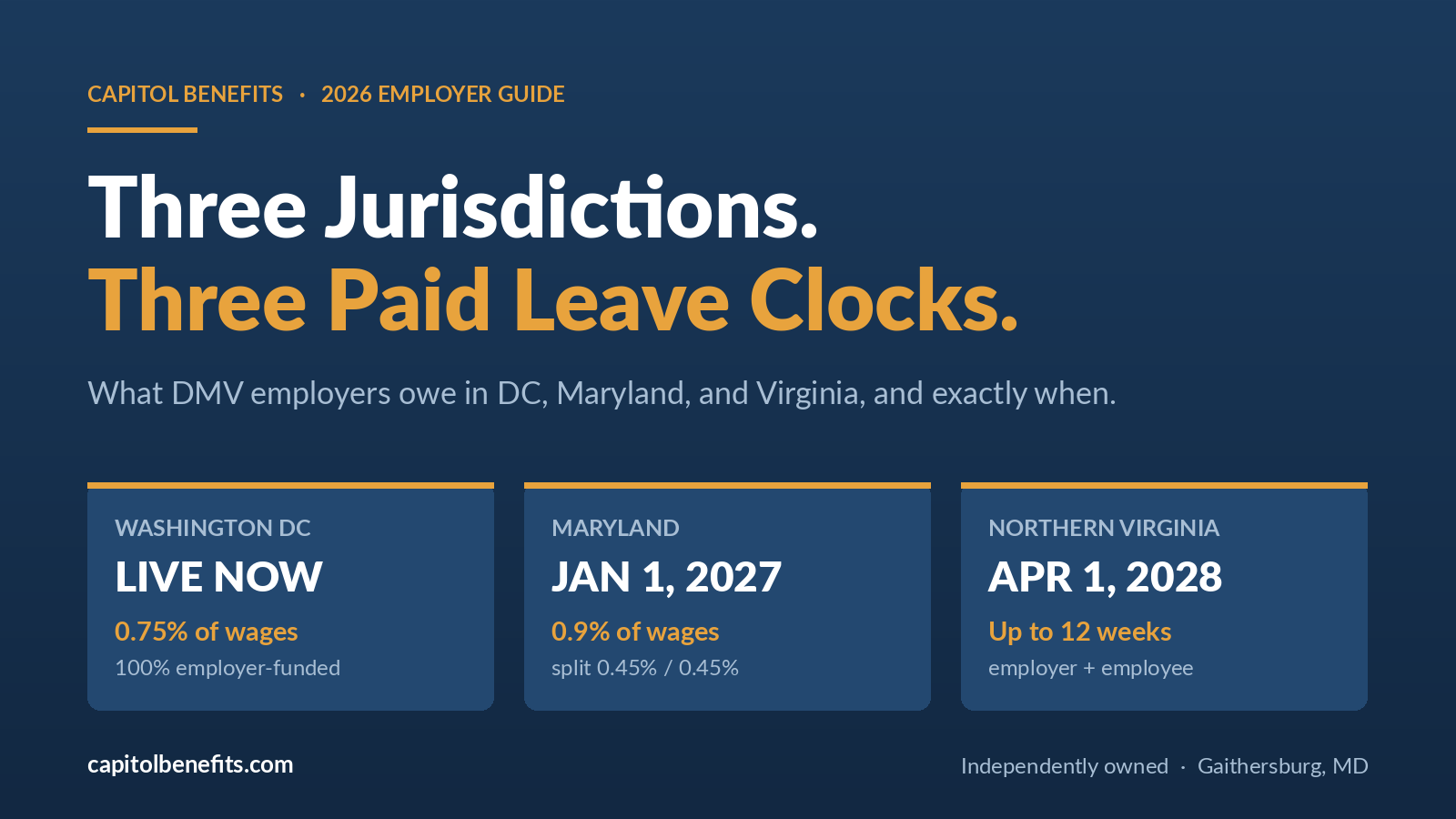
- DC paid family leave is live now and 100% employer-funded at 0.75% of wages. Maryland’s FAMLI contributions start January 1, 2027. Virginia’s start April 1, 2028. All three land inside the next two budget cycles.
- In DC, employers with 1 to 50 full-time equivalent employees must buy small group medical coverage through DC Health Link. Cross 50 and the rules change entirely, which makes headcount a plan-design decision, not just an HR number.
- Virginia has a new paid sick leave law signed May 20, 2026, phasing in by employer size starting July 1, 2027. If you have 50 or more employees, you are in the first wave.
- The one that catches people: if you employ 50 or more full-time employees and even one of them is a DC resident, you owe a separate ACA filing to the DC Office of Tax and Revenue, on top of your federal filing.
A 60-person company headquartered in Tysons hires an engineer who lives in Arlington, a controller who commutes in from Bethesda, and an office manager based in the District. On an org chart, that is one team. On a compliance calendar, it is three separate rulebooks with three separate start dates.
This is the part of running a company in the DMV that nobody warns you about. Most employers we talk to in Northern Virginia, DC, and Montgomery County assume their benefits obligations follow their headquarters. They follow the employee’s work location instead. And over the next 24 months, all three jurisdictions are turning on new payroll-funded leave programs at different times, with different funding splits and different size thresholds.
Here is what actually changes when your team crosses a border, and what to do about it before the deadlines arrive.
Where you are allowed to buy coverage changes at the DC line
Start with the medical plan, because the DMV’s three jurisdictions do not treat the small group market the same way.
Washington DC is the strictest. Small businesses with 1 to 50 full-time equivalent employees must purchase small group medical coverage through the DC Health Link Small Business Marketplace. There is no off-exchange option for that segment. For 2026, DC Health Link offers more than 160 small group plans from three carriers: CareFirst BlueCross BlueShield, Kaiser Permanente, and UnitedHealthcare.
Virginia now runs its own state-based exchange, Virginia’s Insurance Marketplace, operated by the Virginia Health Benefit Exchange under the State Corporation Commission. Small group coverage through the exchange is available to employers with 1 to 50 full-time equivalent employees, and off-exchange options remain. For 2026, Virginia insurers requested an average small group rate increase of 11.2%.
Maryland keeps a conventional small group market with both exchange and off-exchange paths.
The practical consequence for a growing company: the 50-employee line is a plan-design cliff in DC in a way it is not in Maryland or Virginia. If you are a District-based company at 46 employees and planning to hire, you should be modeling what happens at 51 now, not discovering it at renewal. And if you are a multi-state employer, your situs state drives the plan design while your people live everywhere, which makes network adequacy across all three jurisdictions a real question rather than a footnote. A plan built on a tight Maryland network can quietly fail the employee who moved to Fairfax.
Paid family leave: three programs, three clocks, three funding splits
This is the biggest change coming, and it is the one most 20 to 250 employee companies in our market have not budgeted for yet.
All three jurisdictions now have a paid family and medical leave program. None of them work the same way.
Washington DC: live today. The DC Universal Paid Family Leave program is already running. The contribution rate is 0.75% of each covered employee’s total quarterly wages, and the program is 100% employer-funded. You cannot pass any of it to employees. Contributions and quarterly wage reports go to the DC Department of Employment Services.
Maryland: contributions begin January 1, 2027. Maryland’s Family and Medical Leave Insurance program (FAMLI) carries a total contribution rate of 0.9% of wages, split evenly between employer and employee at 0.45% each. Employers with at least 15 employees pay the employer portion and may withhold up to half from employee pay. Employers with fewer than 15 employees do not pay the employer share. They still register, file and remit the employee half, which is 50% of the total rate, and may withhold all of it from employee pay. Benefits become available no later than January 3, 2028.
Virginia: contributions begin April 1, 2028. Virginia’s General Assembly approved a statewide paid family and medical leave insurance program on April 22, 2026, signed into law the following month and administered by the Virginia Employment Commission. Eligible employees will get up to 12 weeks of leave with wage replacement of up to 80% of average weekly wages, subject to a cap. Employers with at least 11 employees remit both portions and may deduct up to 50% from employee wages. Employers with 10 or fewer remit only the employee portion. Benefits start December 1, 2028. Note that the Virginia Employment Commission does not set the actual contribution rate until October 1, 2027, so treat any percentage you see quoted today as an estimate. Employers can apply to satisfy the obligation through a private plan, which is worth a hard look if you already offer strong paid leave.
Read those three paragraphs again as a single sentence: a Reston-headquartered company with people in DC and Silver Spring will stand up three separate payroll-funded leave programs, with three different employer shares, across four budget years. DC is already costing you money. Maryland hits in five months. Virginia follows.
The Virginia private-plan option deserves particular attention. If you already carry a competitive short-term disability and parental leave package, a private plan may be both cheaper and better for your people than the state program. But that is a decision with a 2028 deadline and a 2026 design window, which is exactly the kind of thing that gets postponed until it becomes an emergency.
Paid sick leave: Virginia just joined, and the clock started
Paid sick leave has been settled law in DC and Maryland for years. Virginia’s version is new, and it is the change most likely to catch Northern Virginia employers off guard.
Virginia. Governor Spanberger signed a paid sick leave law on May 20, 2026. Employees accrue at least one hour of paid sick leave per 30 hours worked, up to 40 hours per year, with no waiting period before accrual begins. It phases in by employer size:
- July 1, 2027: employers with 50 or more employees
- January 1, 2028: employers with 25 or more employees
- January 1, 2029: all employers
Two details matter for planning. First, if you already provide at least 40 hours of PTO a year, you may not need a separate sick leave bank, but employees must be able to use up to 40 hours of that PTO for the law’s protected purposes under the law’s conditions. Second, documentation cannot be required until an employee has missed three or more consecutive days. Plenty of existing attendance policies will not survive contact with that rule as written.
Maryland. Under the Maryland Healthy Working Families Act, employers with 15 or more employees provide paid earned sick and safe leave; smaller employers provide unpaid. Accrual is one hour per 30 hours worked, up to 40 hours a year, capped at 64 hours accrued at any one time. Employees can use it after 106 calendar days of employment.
Washington DC. DC’s Accrued Sick and Safe Leave Act ties the accrual rate to employer size, and it is the most generous of the three at the top end:
- 24 or fewer employees: one hour per 87 hours worked, up to 3 days per year
- 25 to 99 employees: one hour per 43 hours worked, up to 5 days per year
- 100 or more employees: one hour per 37 hours worked, up to 7 days per year
- Tipped restaurant and bar employees: one hour per 43 hours worked, up to 5 days per year, regardless of employer size
Employees may begin using accrued leave after 90 days of service, and unused leave carries over.
Notice that all three jurisdictions use a different accrual formula and a different waiting period. A single companywide sick leave policy written to the loosest standard will be out of compliance somewhere. Written to the strictest, it is compliant everywhere but more expensive than it needs to be. That trade-off is a design conversation worth having deliberately rather than by default.
The filing requirement most employers miss
Here is the one we flag most often, because it has nothing to do with where your company is based.
DC has an individual health insurance mandate. If you sponsor an employer-based health plan that covered at least 50 full-time employees during the plan year, and at least one of them is a DC resident, you must submit your ACA reporting (Forms 1094/1095-B and 1094/1095-C) to the DC Office of Tax and Revenue, electronically through MyTax.DC.gov, in the format the agency prescribes. The deadline is 30 days after the federal IRS deadline, including extensions.
An employee counts as a DC resident for this purpose if you withhold wages and pay taxes to DC for any period during the calendar year. So a Gaithersburg or Rockville company with three people living in the District has a District filing obligation, entirely separate from its federal one. This is a filing, not a coverage change, which is precisely why it slips through: nothing about your plan looks different, so nothing prompts the question.
What to do between now and January
None of this requires panic. It requires a map and a calendar. If you have employees in more than one DMV jurisdiction, here is the short list:
- Map your workforce by work location, not by headquarters. Every obligation above keys off where the employee works or lives, not where your office is. Most companies have never built this list.
- Budget the Maryland FAMLI employer share now. Contributions start January 1, 2027, which means it belongs in the budget you are building this fall, not next year’s.
- Decide your PTO architecture before Virginia’s first phase. One combined PTO bank or separate sick leave? Make the call while it is a design choice, not a remediation project.
- Evaluate the Virginia private-plan option. If your paid leave is already strong, a private plan may serve your people better than the state program. That analysis takes months, not weeks.
- Check whether you have a DC filing obligation. Fifty or more full-time employees plus one DC resident is the trigger. Confirm it either way and document the answer.
- Stress-test network adequacy across all three jurisdictions. If your plan’s situs is Maryland and a third of your team is in Northern Virginia, verify their providers are actually in network before someone finds out at an appointment.
Why we wrote this
Capitol Benefits is an independently owned insurance advisory based in Gaithersburg, and nearly every employer client we serve has people across at least two of these three jurisdictions. Multi-jurisdiction compliance is not an edge case in the DMV. It is the default.
Our job is to find these problems before they find you. That means bringing the Maryland FAMLI number to your budget meeting before January, flagging the Virginia phase-in before your policy renewal, and telling you about a DC filing you did not know you owed. Not sending you a compliance newsletter and hoping you read it.
If you have employees in DC, Maryland, or Virginia and you are not certain which of the above applies to you, that is a short conversation with a clear answer. We are glad to walk your roster with you and tell you exactly where you stand.
Frequently Asked Questions
My company is based in Virginia but I have employees in DC and Maryland. Which paid leave rules apply?
All of them, based on where each employee works. Paid family and medical leave obligations follow the employee’s work jurisdiction, not your headquarters. A Virginia-headquartered company with DC employees owes DC paid family leave contributions today at 0.75% of those employees’ wages, will owe Maryland FAMLI contributions on Maryland employees starting January 1, 2027, and will owe Virginia contributions on Virginia employees starting April 1, 2028.
When do Maryland FAMLI contributions actually start, and what will they cost?
Contributions begin January 1, 2027. The total rate is 0.9% of wages, split evenly at 0.45% employer and 0.45% employee. Employers with at least 15 employees pay the employer portion and may withhold up to half from employee pay. Employers with fewer than 15 employees are not required to pay the employer share. Benefits become available to employees no later than January 3, 2028.
Does my Northern Virginia company have to offer paid sick leave?
Yes, on a phased schedule. Virginia’s paid sick leave law, signed May 20, 2026, applies to employers with 50 or more employees starting July 1, 2027, employers with 25 or more starting January 1, 2028, and all employers starting January 1, 2029. Employees accrue one hour per 30 hours worked, up to 40 hours per year. If you already provide at least 40 hours of PTO annually and allow it to be used for the law’s protected purposes, you may not need a separate sick leave bank.
Do small businesses in Washington DC have to buy health insurance through DC Health Link?
Yes, for small group medical coverage. DC employers with 1 to 50 full-time equivalent employees must purchase small group medical coverage through the DC Health Link Small Business Marketplace. For 2026, that market includes more than 160 small group plans from CareFirst BlueCross BlueShield, Kaiser Permanente, and UnitedHealthcare. Once you exceed 50 full-time equivalent employees, different rules apply, which is why growing DC companies should model that threshold in advance.
I am a Maryland employer with a few employees who live in DC. Do I owe DC anything?
Possibly a filing. If your health plan covered at least 50 full-time employees during the plan year and at least one is a DC resident, you must submit your ACA reporting (Forms 1094/1095-B and 1094/1095-C) to the DC Office of Tax and Revenue through MyTax.DC.gov, due 30 days after the federal deadline. An employee counts as a DC resident if you withhold and pay DC taxes for them during the year. You will also owe DC paid family leave contributions on those employees’ wages.
Related reading from Capitol Benefits
- What Group Health Really Costs in the DMV in 2026: Monthly Ranges for 20–250 Employees
- Your Plain-English Guide to Small Business Health Insurance Options (DC, MD, VA)
- Employee Benefits advisory for DMV employers
- Talk to a named advisor about your multi-state roster
This article is general information for DMV employers, not legal or tax advice. Rules, rates, and effective dates change. Confirm your specific obligations with your advisor or counsel before acting.
Ready when you are
Let's take a look at what you've got.
A real review of your current coverage. No deck, no pressure, and usually some money saved along the way.